

AML Policy at JB.COM – How We Prevent Financial Crime
Anti-Money Laundering (AML) is a framework designed to prevent money laundering, terrorist financing, fraud, and other financial crimes. For licensed gaming platforms, AML and Counter-Terrorist Financing (AML/CFT) rules are not optional – they are mandatory regulatory requirements. At JB.COM, operated by Zozo Technology B.V., AML compliance forms part of everyday platform operations and applies to all users.
The platform follows international AML/CFT standards established by the Financial Action Task Force (FATF) and operates under the requirements of the Curaçao Gaming Authority license (CGA OGL/2024/1519/0809). AML measures are designed not only to protect the business but also to safeguard users from account misuse, identity fraud, and participation in illegal financial schemes, including abuse related to JB.COM casino bonuses.
The system works proactively by identifying suspicious behaviour before it escalates into a serious compliance risk.
Key purposes of the AML framework include:
- Preventing illegal financial activity;
- Protecting accounts from misuse;
- Monitoring unusual transaction behaviour;
- Verifying user identity and source of funds;
- Ensuring compliance with international regulations.
The full AML policy is available through:
JB.COM Anti-Money Policy
Legal Framework Behind JB.COM AML Compliance
Zozo Technology B.V., the operator of JB.COM, is registered in Curaçao under registration number 165255 at Kaya Richard J. Beaujon z/n, Willemstad. Operations are conducted under license CGA OGL/2024/1519/0809.
The platform follows a Risk-Based Approach (RBA), meaning compliance measures adapt according to user behaviour, transaction size, geographic location, and activity patterns.
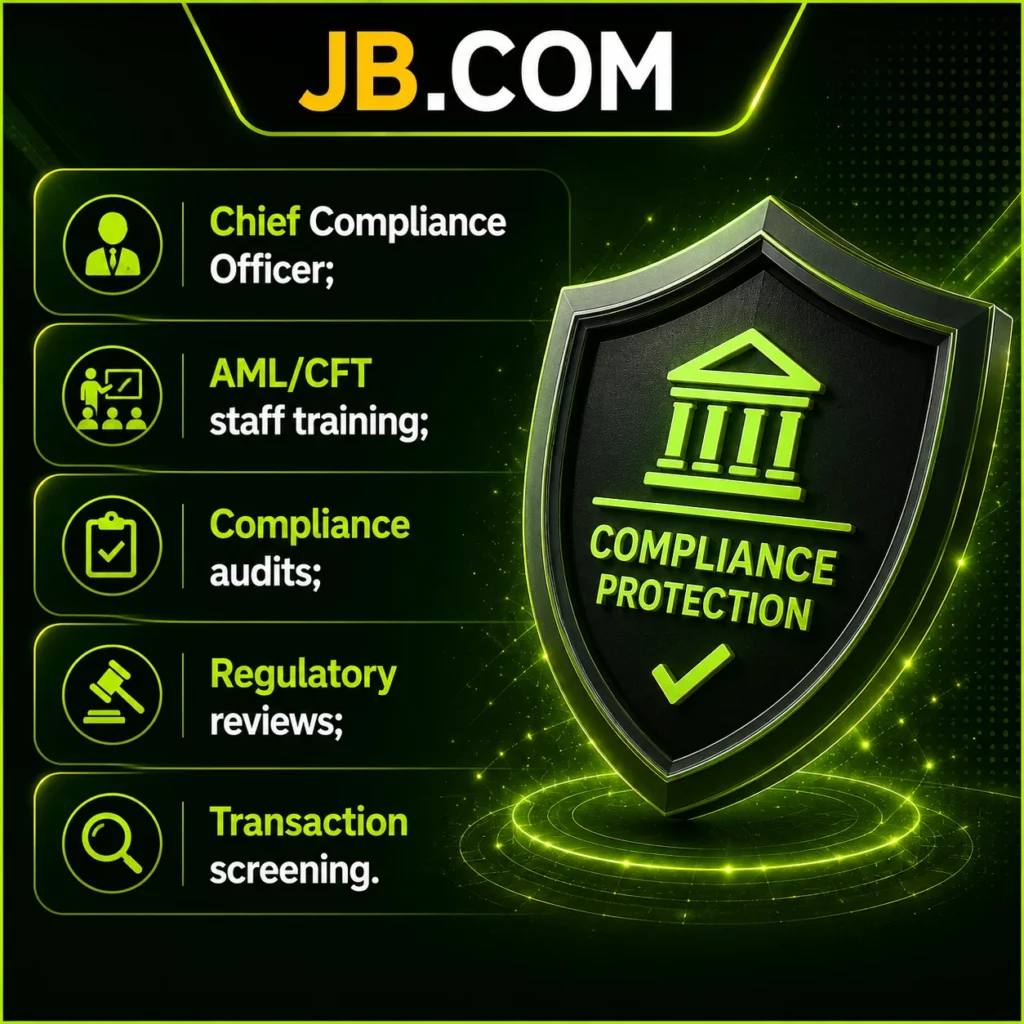
AML oversight at JB.COM includes:
- A designated Chief Compliance Officer;
- Regular AML/CFT employee training;
- Independent compliance audits;
- Ongoing regulatory reviews;
- Continuous transaction screening.
The framework follows FATF guidance, which sets international standards for preventing financial crime across licensed industries.
An important legal principle applies to policy interpretation: the English-language AML document takes legal priority over translated versions.
KYC as Part of AML – What JB.COM Collects and Why
Know Your Customer (KYC) acts as the first layer of AML protection. Before certain financial thresholds are reached or withdrawals are processed, JB.COM may request identity verification to confirm that the account holder is genuine.
KYC helps determine:
- Who the user is;
- Whether the funds appear lawful;
- Whether account activity matches the user profile.
Information collected may include:
| Verification Area | Examples |
|---|---|
| Personal Information | Full name, email, date of birth, country |
| Address Information | Residential address, proof of address |
| Financial Information | Crypto wallet address |
| Identity Documents | Passport, ID card, driving licence |
Standard KYC documentation usually includes:
- Government-issued photo identification;
- Proof of address issued within the last 90 days;
- Additional payment verification if required.
KYC normally becomes mandatory before the first withdrawal or after certain deposit thresholds are reached. Verification generally takes 24–48 hours depending on document quality and account activity.
Enhanced Due Diligence – When JB.COM Requests More
Some situations trigger Enhanced Due Diligence (EDD), which represents a deeper level of compliance review.
EDD may begin if the system identifies:
- Unusually large transactions;
- Betting volumes inconsistent with player history;
- Suspicious deposit and withdrawal patterns;
- Wallets linked to sanctions databases;
- High-risk blockchain activity.
During EDD, the account may be temporarily suspended while additional information is requested.
Supporting documents may include:
- Source of funds evidence;
- Bank or crypto statements;
- Proof of ownership of payment methods;
- Additional identity checks.
Temporary suspension does not automatically mean permanent closure. If the review is completed successfully, account access resumes.
For larger transactions, keeping financial records available in advance can significantly reduce delays.
Transaction Monitoring at JB.COM – How It Works
JB.COM combines automated systems with manual compliance review to monitor financial activity in real time.
The monitoring system screens transactions for suspicious behaviour patterns, including:
- Minimal-risk betting strategies;
- Structuring large sums into smaller deposits;
- Unusual withdrawal behaviour;
- Suspicious crypto wallet activity;
- Patterns inconsistent with account history.
Blockchain addresses are also screened through third-party analytics providers against sanctions lists and known high-risk databases.
Every withdrawal undergoes internal review before approval. Because of this process, temporary delays should be treated as a standard compliance procedure rather than evidence of account restrictions.
Internal monitoring is designed to balance speed with security.
Prohibited Activities and Restricted Jurisdictions at JB.COM
Certain activities are explicitly prohibited under AML rules.
Restricted practices include:
- Corporate or business accounts;
- Cryptocurrency mixers and tumblers;
- Peer-to-peer transfers between users;
- Multi-accounting;
- Providing false identity details.
Only individual accounts are permitted, and verification applies exclusively to natural persons.
Restricted jurisdictions include:
- United States;
- Iran;
- Cuba;
- North Korea;
- Syria;
- Crimea.
JB.COM applies geolocation checks, timezone analysis, and technical monitoring to detect VPN use intended to bypass restrictions.
Using VPN tools to access blocked regions violates platform rules and may result in account closure and confiscation of funds.
Cryptocurrency Transactions and AML at JB.COM
JB.COM supports more than 80 cryptocurrencies, but cryptocurrency transactions are not treated as anonymous from a compliance perspective.
Every wallet address undergoes blockchain screening to assess transaction history and associated risks.
The monitoring system may flag addresses connected to:
- Sanctioned entities;
- Darknet marketplaces;
- Fraud investigations;
- High-risk mixers;
- Suspicious transaction networks.
If funds arrive from a high-risk address, the account may enter EDD review before further activity becomes available.
To reduce compliance issues, users are encouraged to:
- Use only personal wallets;
- Avoid receiving funds from unknown sources;
- Verify wallet history before depositing;
- Avoid third-party intermediaries.
Why JB.COM Cannot Accept Mixer Transactions
Crypto mixers and tumblers are prohibited because they intentionally obscure the origin of funds.
A mixer works by blending cryptocurrency from multiple users to hide transaction history. While some users view this as a privacy feature, AML regulations treat it as a significant compliance concern.
The problem is simple: if the source of funds cannot be verified, AML obligations cannot be fulfilled.
Blockchain analytics tools are capable of identifying mixer-related transactions even after funds move through several wallet layers.
Funds associated with mixers may:
- Trigger account suspension;
- Enter AML investigation;
- Be frozen temporarily;
- Be returned following review.
This is not a discretionary platform preference but a regulatory requirement tied to AML/CFT obligations.
User Obligations Under JB.COM AML Policy
AML compliance also creates responsibilities for users.
Account holders are expected to:
- Provide accurate registration and KYC information;
- Avoid sharing account access with third parties;
- Keep proof of funds for larger transactions;
- Report suspicious account access immediately;
- Avoid illegal financial activity through the platform.
Failure to comply with AML rules may result in:
- Account suspension;
- Permanent account closure;
- Confiscation of funds;
- Reporting to regulatory authorities.
AML obligations apply equally to both the platform and its users.
FAQ
No. Verification must match the registered account owner exactly.
Withdrawal reviews are part of standard AML monitoring and may occur even on verified accounts.
No. Crypto wallet activity still undergoes blockchain screening and sanctions monitoring.
Yes. If EDD or additional compliance checks are necessary, the platform will contact you directly.
It is generally recommended to use a personal wallet to avoid ownership verification issues during AML checks.